



WEEEKLY MOTIVATION
BLOCK TEN MINUTES FOR ONE TASK NOW.
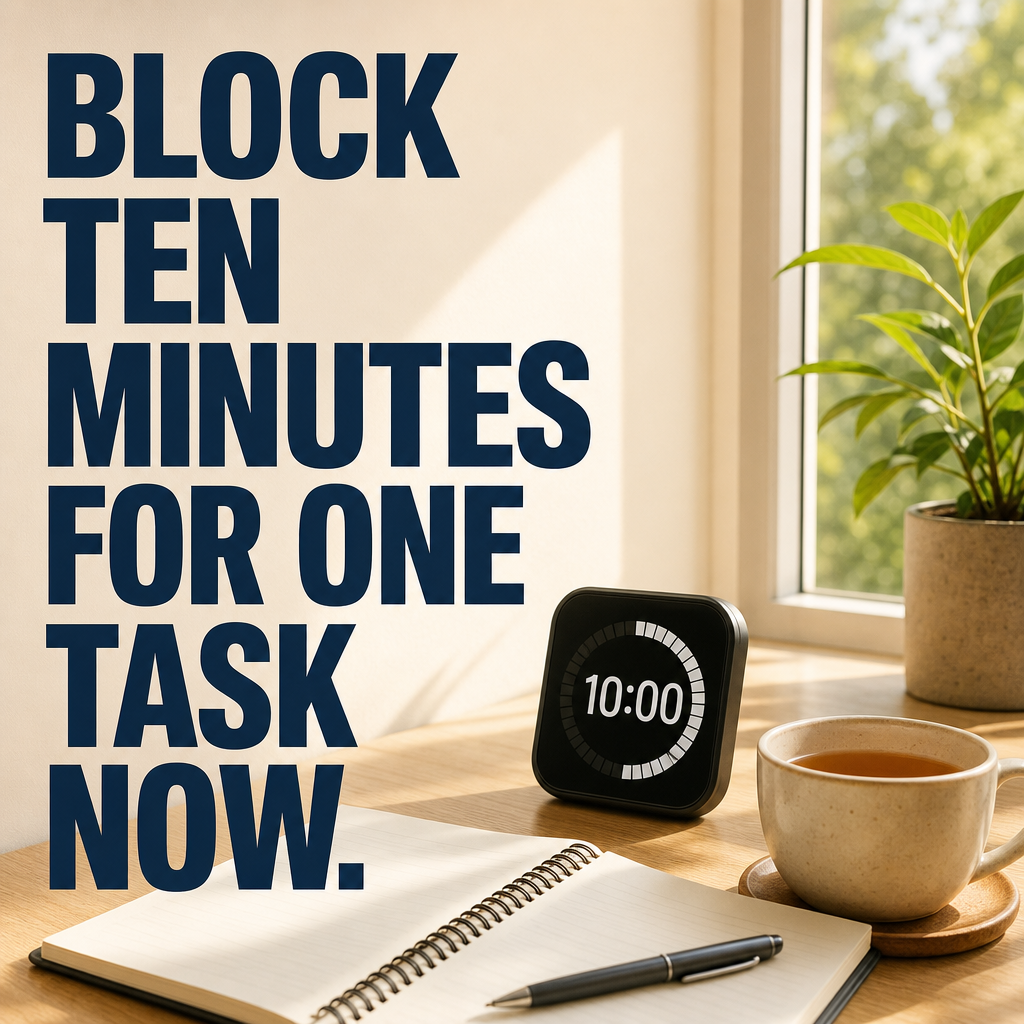
Open your calendar or set a timer, and block off ten minutes for a single task—right now, as you read.
Work with Focus: Time-Box a Task, Change Your Day
Ever notice how your to-do list shrinks in theory, but stretches endlessly in real life? Maybe you sit down to pay bills, write a report, or just organize your desk—and a flood of emails, messages, or second thoughts pulls you off course. By the time you glance at the clock, the task is still looming, and your energy is already frayed. You’re not alone. Focus is tough in a world designed to splinter attention. But the secret isn’t about having superhuman willpower or finding the perfect productivity trick. In fact, research supports something smaller, and simpler: draw a line around one block of time for one task—and let yourself step fully inside it. This week, we explore why deliberately “time-boxing” even just ten minutes can refresh your focus, protect your energy, and make progress feel possible—no perfection required.
Why Time-Boxing Works (Even for Everyday Goals)
Big promises about deep work and perfect routines are tempting—but evidence shows moderate, reliable gains come from basic time management habits, like time-boxing. One large meta-analysis (over 53,000 people) found time management tactics, including scheduling tasks into blocks, improve work and study performance—and even wellbeing ([journals.plos.org](https://journals.plos.org/plosone/article?id=10.1371%2Fjournal.pone.0245066&utm_source=openai)).
But you don’t need a whole new system. Time-boxing works because it sets a safe boundary: a short, specific period where one thing matters. When you block even a small window (like ten minutes), your mind gets permission to lay aside everything else—for now. Instead of fighting for focus, you create a pocket of protection.
A Surprising Truth: Short Blocks Pack Power
Most of us assume real focus requires hours of silence, or complex schedules. But studies and practical experience both suggest the opposite. Limiting a task to one small chunk of time actually makes it easier to start and finish—especially when motivation is low or distraction lurks nearby.
In fact, surveys of professionals and everyday workers rank time-boxing as the most useful productivity method out there ([hbr.org](https://hbr.org/2018/12/how-timeboxing-works-and-why-it-will-make-you-more-productive?utm_source=openai)). Why? Because a small, visible time limit turns effort into something manageable. There’s no need to finish everything, just to show up for the task you chose. When the block ends, you decide to keep going—or enjoy a little satisfaction from a promise kept.
Hypothetical Example: Layla’s Ten-Minute Block
Imagine Layla, who feels drained by unending emails and half-finished chores. She wants to write a cover letter, but it keeps getting pushed behind urgent pings and tiny distractions. Instead of waiting for a free afternoon, Layla opens her phone calendar, picks ‘2:00–2:10pm: Start cover letter,’ and sets an alert.
Ten minutes later, she’s surprised: While she didn’t finish, she wrote a draft paragraph and outlined her main points. The task is less intimidating now that real words exist, and she leaves the ten minutes knowing exactly where to pick up next. The rest of the afternoon, work feels a little less chaotic. Layla’s calendar block didn’t guarantee a finished letter, but it carved out a protected time for focus—and gave her momentum to build on.
Try It: Draw Your Line, Right Now
Here’s your practical step: Don’t wait for the ideal moment. As soon as you finish reading this post, open your phone’s calendar or set a timer, and block off the next ten minutes for just one task you care about. No rearranging your whole day, no need to finish the job—just pick something that deserves your attention, and give it a short, protected window.
If the block feels too small, remember: The evidence suggests measurable progress—and even a boost in wellbeing—can come from modest, regular windows of focused time. If you want, you can always add another block later. But one ten-minute line is enough to reclaim your focus from the current scatter, and give your effort somewhere to land now.